
"Over the years of reviewing casino platforms for Indian users, we have tested dozens of game formats. The main conclusion is that a blackjack game requires you to completely understand the rules and payout policies before your first deposit, not after." - Nisha Rao, Casino and Betting India
Quick summary for Indian players: Blackjack is one of the fairest casino card games you can play online, with a house edge as low as 0.5% when you follow basic strategy. This guide covers the complete rules, step-by-step online play, live dealer vs RNG differences, beginner strategy, and how to pick a safe platform that supports INR and UPI. Online gambling laws in India vary by state. Some states such as Telangana and Andhra Pradesh prohibit online casino play entirely, so always verify local regulations before depositing real money.
Legal and risk notice: Real-money casino play depends on localised laws in India, which differ heavily by state. Gambling inherently involves financial risk. This content is not a substitute for professional legal or financial advice, and casino play is never a guaranteed path to profit. Always set strict time and money limits before you begin.
Blackjack: Rules, Online Play, Live Tables and Winning Basics
What is blackjack and what is the goal of the game
Blackjack is a comparing card game. The goal? Get a hand total closer to 21 than the dealer, without going over. That sounds simple, but the nuance matters. Success depends entirely on beating the dealer's hand, not on mathematically chasing 21 at all costs. If both you and the dealer finish at 21, the result is just a push (a tie). The objective is comparative, not absolute.
Every round comes down to comparing your total against the dealer's. You act first. The dealer follows. This sequence creates a structured game of risk management where your decisions directly shape outcomes. It is worth pausing on that point, actually, because acting first is where most of the house edge comes from.
"Blackjack can be modelled as a finite Markov chain, where each state encodes the player's running total, the dealer's visible card, and the remaining deck composition." - Colorado School of Mines, Markov-chain analysis of blackjack strategy (2024). https://arxiv.org/abs/2024-colorado-mines-blackjack
For users in India, treating a blackjack casino session as paid entertainment rather than an income source remains the safest approach. Set a loss limit before the first hand. If you are looking for licensed casino platforms that support INR deposits, verify their regulatory credentials and payout policies before committing any funds.
How a blackjack hand starts with the first two cards
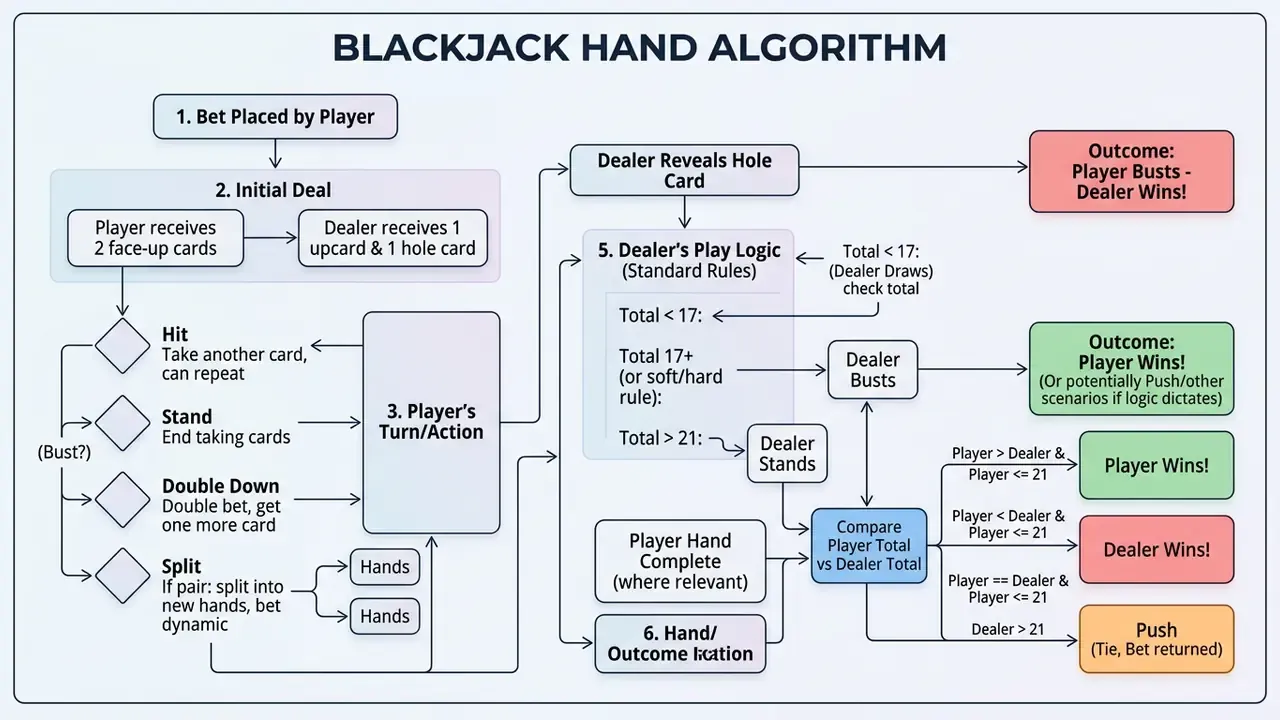
A blackjack hand begins with the initial deal. Here is exactly how a standard round starts:
- Place your bet: Select a chip denomination and place it inside the digital betting box before the timer (typically 5 to 15 seconds) expires.
- Receive your cards: You get two cards face-up. The dealer receives one card face-up (the upcard) and one face-down (the hole card).
- Calculate your total: Add the point values of your two cards (details in the next section).
- Make your move: Choose to hit, stand, double down, or split based on your total and the dealer's visible card.
The first two cards are crucial for evaluating your mathematical position. In American-style blackjack, the dealer's hole card stays hidden until players finish their actions.
European conventions sometimes deal the dealer's second card only after all players have acted. If your initial two cards consist of an Ace and a 10-value card, you hold a natural blackjack. Under standard casino rules, this combination often results in an immediate payout unless the dealer holds the same hand.
Before taking action with your INR bankroll via UPI or NetBanking, verify whether the platform offers the standard 3:2 payout for these opening hands. Some tables pay only 6:5, which is significantly worse for you. That difference alone can shift the house edge by roughly 1.4%.
What counts as a win, loss or bust
You secure a win if your final hand total is higher than the dealer's without exceeding 21, or if the dealer's hand exceeds 21 (busts). A loss happens when your total is lower than the dealer's, or if your cards bust by going over 21.
A bust instantly ends the round for a player. In probability terms, bust is an absorbing state: once your total exceeds 21, the outcome is locked immediately, regardless of what happens with the dealer's hand afterward.
"Bust is an absorbing state of the chain - once the total exceeds 21, the outcome is fixed immediately, irrespective of the dealer's hand." - Colorado School of Mines, Markov-chain analysis of blackjack strategy (2024). https://arxiv.org/abs/2024-colorado-mines-blackjack
If both the player and the dealer finish with the exact same hand value, it is called a push, meaning the original wager is returned without profit. According to official casino rule structures, such as those defined by the Nevada Gaming Control Board, the dealer's bust guarantees a payout for any player still active in the round.
Blackjack rules every player should know before playing
The fundamental blackjack rules require understanding card points, the sequence of player turns, and the fixed conditions governing the dealer's actions. Players always make their decisions first, placing the burden of risk on them before the dealer moves.
"A blackjack game requires you to completely understand the rules and payout policies before your first deposit, not after." - Nisha Rao, Casino and Betting India
Basic rules dictate how the flow operates at blackjack tables. After receiving the cards, participants select actions based entirely on their current hand. The dealer is heavily regulated: they must draw cards until they reach a minimum total, usually 17. The game is mathematically asymmetric. You have options; the dealer does not. Whether you play online blackjack or sit at a physical venue, the sequence remains identical. Start with demo mode if you want to test the mechanics before risking your budget.
Card values and how hand totals are counted
| Card | Point Value |
|---|---|
| 2 through 10 | Face value (2 = 2 points, 7 = 7 points, etc.) |
| Jack, Queen, King | 10 points each |
| Ace | 1 or 11 (whichever benefits your hand) |
Hand totals are computed by summing the individual point values of your cards. Any hand containing an Ace counted as 11 is known as a soft hand, which carries limited exposure to a bust. Conversely, if the Ace must count as 1 to avoid a bust, it forms a hard hand. For instance, an Ace and a 6 is a soft 17, but hitting it and drawing a 10 changes it to a hard 17. That flexibility is what makes the Ace the most valuable card in the deck.
"The Ace counts as 11 unless that would cause a bust, in which case its value drops to 1 - this is the standard across all regulated blackjack variants." - California Bureau of Gambling Control, Proposed Blackjack Regulations (2024). https://www.bcg.ca.gov/proposed-blackjack-regulations-2024
These card values form the core of every strategy decision you will make at the table. The Ace's flexibility is your best protection against busting early, and understanding when your hand is soft versus hard changes every move you make.

When to hit, stand, double or split
You should hit to draw another card, stand to hold your total, double to increase your bet for exactly one more card, or split matching cards into two separate hands. These decisions depend directly on evaluating your total versus the dealer's visible card.
Here are specific scenarios every beginner should memorise:
- Always split Aces and 8s. Two 8s give you 16, the worst hand in blackjack. Splitting gives you two fresh chances at building a strong hand. Splitting Aces gives you two shots at hitting 21.
- Never split 10s or 5s. A pair of 10s is already a strong 20. A pair of 5s totals 10, which is a perfect doubling hand.
- Double down on hard 11. Always double when your first two cards total 11 and the dealer shows anything lower than an Ace.
- Stand on hard 17 or higher. The risk of busting outweighs the potential gain.
- Surrender a hard 16 against dealer 9, 10, or Ace. If the table allows it, surrendering saves half your bet on one of the worst hands.
- Hit on 12 through 16 if the dealer shows 7 or higher. The dealer is likely to make a strong hand, so you must try to improve.
A case from a recent review illustrates this well: a user continuously split 10s, thinking it increased their chances. After reading a responsible gambling framework on basic logic, they stopped splitting winning hands and preserved their bankroll significantly longer. Small adjustments like that matter more than people expect.
Insurance, surrender and other table options
Insurance is a side bet against the dealer holding a blackjack, while surrender allows players to forfeit half their wager to exit a weak hand early. These options appear at real-money tables, but their value varies heavily.
Insurance is generally a poor bet for players. In the Markov-chain model of blackjack, insurance is described as an optional side wager of half the original bet (B/2), and it is only mathematically favourable when the deck contains an unusually high proportion of ten-value cards. That is a rare condition in standard play. The 2:1 payout fails to compensate for the true odds, giving the house a substantial edge on this specific bet.
"In the Markov-chain model, insurance is an optional side bet of B/2 that is advantageous only when the remaining deck has an anomalously high concentration of ten-value cards." - Colorado School of Mines, Markov-chain analysis of blackjack strategy (2024). https://arxiv.org/abs/2024-colorado-mines-blackjack
Surrender is beneficial when holding a weak 16 against a dealer's strong 9, 10, or Ace upcard. The basic strategies here: a hard 16 surrenders against a dealer's 9, 10, or Ace, and a hard 15 surrenders against a dealer's 10. The purpose is simple. Giving up half your bet is far more profitable than losing the entire hand.
Disclaimer: Information about insurance odds and surrender strategy is provided for educational purposes only and does not constitute financial advice. Always gamble responsibly and within your means.
- Hit:Requesting an additional card to increase the hand total.
- Stand:Refusing further cards and ending your active turn.
- Double Down:Doubling the initial wager in exchange for receiving exactly one more card.
- Split:Dividing a starting pair into two separate hands, each with an equal new bet.
- Surrender:Giving up a hand immediately to save half of the original wager.
- Insurance:An optional side bet placed when the dealer shows an Ace, paying 2:1 if the dealer has 21.
- Bust:Exceeding 21 points, resulting in an automatic and immediate loss.
- Push:A tie where player and dealer finish with the same total, and the original bet is returned.
- Dealer:The casino representative strictly bound by automated hitting and standing rules.
Blackjack strategy basics for beginners
Basic strategy is a mathematically backed decision chart dictating exactly when to hit, stand, double, or split based purely on your current points and the dealer's visible card. It entirely ignores gut feelings in favour of maximum expected value.
"Dynamic programming on an eight-deck shoe confirms that basic strategy minimises the house edge when blackjack pays 3:2." - Optimal blackjack betting strategies, dynamic programming preprint (2025). https://arxiv.org/abs/2025-blackjack-dynamic-programming
In competitive blackjack games, emotional decisions yield long-term vulnerability. Sticking strictly to a baseline framework effectively minimises the casino's advantage to around 0.5%. It does not guarantee cashouts under any scenario, but following fundamental rules actively prevents rapidly draining your bankroll. Think of it as a defensive mechanism to stretch your entertainment budget.
How to make better decisions with your hand total
Match your current hand total against the dealer's upcard using proven strategy charts to decide the highest-probability action. Here is a simplified reference:
| Your Hand | Dealer Shows 2 through 6 | Dealer Shows 7 through Ace |
|---|---|---|
| Hard 8 or less | Always Hit | Always Hit |
| Hard 9 | Double (otherwise Hit) | Hit |
| Hard 10 or 11 | Double (otherwise Hit) | Double on 11; Hit on 10 vs Ace |
| Hard 12 through 16 | Stand | Hit |
| Hard 17+ | Always Stand | Always Stand |
| Soft 13 through 17 | Hit or Double | Hit |
| Soft 18 | Stand (Double vs 3 through 6) | Hit vs 9, 10, Ace; Stand vs 7 or 8 |
| Soft 19 through 21 | Always Stand | Always Stand |
| Pair of A or 8 | Always Split | Always Split |
| Pair of 10, 5, 4 | Never Split | Never Split |
Save this chart to your phone and keep it open during your first sessions. Looking up the correct move is far smarter than guessing.
The mathematics of gambling confirms that taking calculated risks, such as doubling your wager on a hard 11, maximises your odds of establishing a competitive point spread. You must stand firm on weak totals like 12 to 16 if the dealer's hand displays a vulnerable card from 2 through 6. Following this math strictly improves your survival rate over testing intuition. And honestly, that discipline is what separates players who last from those who don't.
Common mistakes that make players lose more often
Beginners frequently misplay by taking insurance bets, playing based on momentary intuition, and failing to split favourable pairs like Aces and eights. Chasing losses after a bad streak severely accelerates budget depletion.
An observational study published in Addictive Behaviors in 2024 evaluated casino interactions and noted that chasing wins or trying to quickly recover losses results in hazardous habits. Specifically, the study found that roulette players returned significantly faster after profitable sessions (b=-0.13, p<0.001), while for blackjack the chasing pattern was statistically similar to slots.
"Between-session chasing of losses and wins in an online eCasino." - Addictive Behaviors (2024). https://www.sciencedirect.com/addictive-behaviors-2024-chasing
Treating the session calmly while strictly following the mathematics prevents over-reliance on hunches. Emotional blackjack playing is fundamentally a red flag for your bankroll.
Fact Check: Verifying Blackjack Myths Myth: You can win steadily using intuition alone. Fact: Mathematical analysis by Wizard of Odds calculates that intuition inflates the house edge to 2 through 5%, whereas basic strategy restricts it to near 0.5%. Myth: All blackjack tables offer identical odds. Fact: Rule variations heavily shift the mathematical outcome. A 6:5 payout drastically hurts player prospects compared to a classic 3:2. Myth: Live blackjack automatically pays out better. Fact: Expected returns rely entirely on written table rules, not on the physical existence of a human dealer.
Advanced tactic: the Hi-Lo card count
While impossible in standard RNG online games (the deck is shuffled after every hand), live tables with multiple decks sometimes allow basic counting. The Hi-Lo method works like this:
- Assign values: Cards 2 through 6 = +1. Cards 7 through 9 = 0. Cards 10, J, Q, K, A = -1.
- Keep a running count: Start at zero and adjust after every card you see on the table.
- Calculate the true count: Divide the running count by the estimated number of decks remaining in the shoe.
- Adjust your bets: A high positive true count means more high cards remain in the shoe, which favours the player. Increase your bet modestly. A negative count favours the house, so bet the table minimum.
Card counting is not illegal, but casinos reserve the right to restrict or ban players they suspect of counting. In online environments, this technique offers no advantage because the virtual deck is reshuffled between every hand. Worth knowing about, but not something to rely on for your regular sessions.
How to play blackjack online step by step
Playing online blackjack involves selecting stakes through a digital interface, placing a digital wager, receiving virtual cards via a Random Number Generator (RNG), and using on-screen buttons to resolve the hand. The platform manages payouts instantly without manual oversight.
"In regulated online casinos, such as those in Pennsylvania, licensed operators must use geolocation technology and certified random number generators for all table games." - Pennsylvania 2024 Online Gambling Report. https://www.pgcb.pa.gov/online-gambling-report-2024
The interactive flow mirrors physical casino floors but removes physical friction. When you play blackjack online, your local Indian payment method (UPI, NetBanking, or an INR-friendly digital wallet) securely funds your balance. Always confirm that the casino holds a valid licence and uses certified RNG engines before initiating any real-money transaction.
From placing bets to receiving your cards
You initiate a round by clicking chip denominations and placing them inside the digital betting box before the short timer expires. The software then deals your starting hand against the dealer.
Every platform sets a specific time window, typically 5 to 15 seconds, to make your wager. Once confirmed, you hit the "Deal" button. Two cards appear face-up instantly. For users in India, watching out for currency conversion friction is critical if INR is not natively supported. These initial interface details decide how comfortable the gaming experience is. A platform that forces you to convert to USD before every bet quietly eats into your bankroll through exchange fees.
How the dealer completes the round online
The casino server automatically completes the dealer's turn based on coded rules without active human intervention. Results and payouts are calculated in milliseconds using certified logic isolated from the RNG.
For standard online blackjack, the dealer's upcard dictates whether the software continues drawing. Most online platforms require the dealer to hit on soft 17 and stand on hard 17, though this varies by game variant. Always check the info panel before playing. The structural separation between the RNG and the payout module guarantees the dealer's hand does not adapt to your behaviour. That separation is what makes certified platforms trustworthy.
Live blackjack vs standard online blackjack: what changes for the player
Live blackjack streams a human dealer managing physical cards to your device, while standard online formats use automated RNG software. The primary changes lie in game pacing, social interaction, network demands, and betting limits, rather than mathematical odds.
Live sessions typically deal roughly 50 to 70 hands per hour, a sharp contrast to the 150+ hands typical of standard RNG tables. The seamless integration of high-definition video requires stable connectivity, meaning Indian players need a reliable mobile network or Wi-Fi connection. A blackjack casino with live facilities provides an authentic studio atmosphere but frequently demands higher minimum stakes due to operating costs.
When live dealers make more sense than RNG games
Opting for live dealers is better when you seek visual transparency, social chat features, and the traditional physical card-shuffling experience. It reduces scepticism for players who distrust automated software systems.
A 2024 behavioural tracking study found clear evidence of win-chasing: players returned faster after profitable sessions than after losing ones. This pattern was even stronger in live environments, where the visible human element created a heightened sense of engagement.
"Players returned significantly faster after profitable sessions, with clear between-session chasing patterns observed across game types." - Addictive Behaviors, "Between-session chasing of losses and wins in an online eCasino" (2024). https://www.sciencedirect.com/addictive-behaviors-2024-chasing
Standard RNG games effectively isolate you in a digital space, whereas live environments build measurable consumer trust through real-time dealing confirmation. Be aware, however, that this sense of trust can also lead to longer sessions and higher spending. Keep your time limits firm. That is not a suggestion; it is the single most important habit for live blackjack players.
What to check before joining live blackjack tables
Prior to joining, carefully evaluate these five critical parameters:
- Table minimums: Confirm they match your budget. Live tables typically start at ₹100 to ₹500, while RNG tables may start as low as ₹10.
- Internet speed: A live dealer stream requires a stable connection of at least 5 Mbps to run smoothly in HD. Slower connections may cause missed decision timers, resulting in automatic stands.
- Payout rules: Verify that the specific table pays 3:2 for a natural blackjack, not 6:5.
- Bet Behind option: Some tables let you wager on another player's hand when all seats are full.
- Mobile usability: Check that the lobby interface works well on your phone. Screen layout, button size, and chat visibility all matter during fast-paced rounds.
Investigate the specific rules before depositing. If you are searching for online casino platforms with live blackjack, compare multiple providers' rule sets before committing.
Comparison of Live vs Standard Online Blackjack
| Feature | Standard Online Blackjack (RNG) | Live Online Blackjack |
|---|---|---|
| Dealer presence | Automated algorithmic system, no human | Real human dealer using physical cards |
| Speed | Very fast (150+ hands per hour) | Moderate pace (50 to 70 hands per hour) |
| Table feel | Solitary, purely digital interface | Social interaction, land-based casino atmosphere |
| Betting range | Micro-stakes available (from ₹10) | Higher minimums (typically ₹100 to ₹500+) |
| Battery and data usage | Very low data consumption on mobile | High battery and data drain (continuous video stream) |
Standard RNG variations favour fast-paced budget sessions for mobile users, while the live dealer option suits players seeking atmospheric verification, despite the heavy mobile data usage. Pick based on your connection quality and session budget, not just preference.
Popular blackjack variations you can play online
Not all blackjack games use the same ruleset. Understanding the differences between variants helps you pick the game that best matches your skill level and budget. Here are the most common ones you will encounter:
- Single Deck Blackjack:Played with just 52 cards, offering the lowest base house edge, provided the table pays 3:2. Fewer cards also make it easier to track what has been dealt.
- Double Exposure Blackjack:Both of the dealer's cards are dealt face up, giving you a massive information advantage. To compensate, the dealer wins all ties, and blackjack pays even money (1:1) instead of 3:2.
- Super 7 Blackjack:Features a side bet that pays out if your first card is a 7. Payouts multiply if you receive consecutive 7s, with suited 7-7-7 potentially paying up to 5,000x your side wager.
- Spanish Blackjack:Played without the four 10-value cards (only face cards remain). This increases the house edge, but the game compensates with liberal doubling and bonus payouts for specific hand combinations.
- Pontoon:The British cousin of blackjack. Both dealer cards are face-down, you must hit on 14 or less, and a five-card hand that does not bust (a "five-card trick") beats everything except a natural pontoon (Ace + 10).
Each variant tweaks the mathematics, so check the rule summary in the game's info panel before betting. A game with an appealing name might carry a significantly higher house edge than classic blackjack. I have seen players jump into Spanish Blackjack without realising the missing 10s shift the odds considerably.
Can you win at blackjack and what affects your chances
You can achieve a winning session, but the house mathematically retains a long-term advantage under all standard conditions. Your actual chances fluctuate based on the explicit rules in place and your personal decision discipline.
Disclaimer: The information below is educational. No strategy eliminates the house edge entirely. Blackjack is a form of paid entertainment, not a reliable income source.
While basic strategy narrows the operator's lead to around 0.5%, the dealer always acts last, which is a massive structural advantage. This makes blackjack one of the fairest selections compared to heavily weighted slot layouts (which carry a 5 to 10% house edge), yet it remains a paid form of entertainment. Check the payout rules before your first deposit.
How rules and table variations change your edge
Casino rules like limiting doubling options, removing the surrender option, or enforcing a 6:5 payout ratio drastically expand the house edge. Favourable variations, in contrast, measurably reduce the casino's advantage.
Moving from a classic 3:2 payout to a 6:5 setup increases the house edge by approximately 1.4%. This figure comes from standard probability models: when a natural blackjack pays 6:5 instead of 3:2, you lose a significant portion of expected winnings on every blackjack hand.
"Colorado gaming regulations establish a minimum blackjack payout of 6:5, a less favourable standard than the classic 3:2, confirmed by Markov-chain modelling." - Colorado Division of Gaming, Blackjack Rules (2024). https://www.colorado.gov/gaming/blackjack-rules
When a dealer hits a soft 17 instead of standing, the operator's advantage climbs by an additional 0.20 to 0.22%, depending on the number of decks in play. Always identify these parameters explicitly in the terms and conditions before playing.
A useful case illustrates this: a user registered at a platform offering 6:5 payouts, unaware of the impact. After reviewing the Wizard of Odds analysis explaining the edge detriment, the user switched to an alternative 3:2 table, securing far better baseline conditions for their balance. The lesson is straightforward: read the payout ratio before you sit down.
Why betting discipline matters as much as strategy
Establishing a strict flat-betting threshold actively protects your wallet from dramatic variance and rapid loss scenarios. Placing precise wagers equal to 1 to 2% of your entire budget stabilises your game rhythm.
"Optimising bet size through dynamic programming reduces the probability of ruin without altering the expected value per unit wagered." - Optimal blackjack betting strategies, dynamic programming preprint (2025). https://arxiv.org/abs/2025-blackjack-dynamic-programming
Discipline strongly mitigates emotional betting. Setting a loss limit before the first hand translates directly into sizing your bets correctly. Bankroll management remains critically important because losing streaks mathematically occur regardless of rules. Keeping the wager size uniform heavily reduces immediate exposure to sudden swings. If you walk into a session without a number in mind, you have already made your first mistake.
How to choose a blackjack casino or game offer
Select licensed platforms that process local payouts swiftly via UPI, feature favourable 3:2 game rules, and prominently display responsible gambling tools. Evaluate promotional limits tied specifically to table games and wagering conditions.
Navigating the landscape requires prioritising transparency and trust signals above flashy banners. For iGaming platform selection, ensure the operator implements straightforward KYC verifications reliably while natively supporting INR. Assess the interface for immediate mobile-first playability. Speed and UX should provide an effortless session, especially on mid-range Android devices common in India.
What makes one blackjack game or table better than another
A superior table inherently provides the traditional 3:2 payoff on a natural, allows basic splitting without excessive restrictions, and establishes table limits matching your comfortable play scale. Fast, auditable rules equal a safer space.
It is crucial to avoid hidden restrictive clauses. Good tables let you utilise surrender in disadvantageous spots and force the dealer to stand on all 17s. Smooth usability across mobile platforms ensures you never miss a decision window. If the interface forces you to scroll or zoom to find the hit button, that is a red flag for the platform's overall quality.
How to evaluate offers before you start playing
Read through the bonus terms clearly, inspecting exactly how much table wagers contribute towards satisfying the wagering requirements. A large promotional package is not always a better value.
In numerous instances, playing online blackjack contributes merely 5% to 10% toward unlocking welcome bonus funds, meaning you must play significantly longer to initiate a withdrawal. That is not a minor detail. On a 30x wagering requirement with 5% contribution, you would need to wager 600 times the bonus amount at the blackjack table to clear it.
"Pennsylvania's 2024 report notes that operators actively use promotional credits to attract players, yet wagering conditions significantly affect the real value of any bonus." - Pennsylvania 2024 Online Gambling Report. https://www.pgcb.pa.gov/online-gambling-report-2024
Compare the terms meticulously before you claim any offer. Ignore the marketing fog. If the wagering contribution remains poor, bypassing the bonus entirely generally serves you better.
Legal and access disclaimer: Availability of blackjack casino offers, real money play, and live blackjack depends on local rules and operator terms. Laws in India differ by state, and platform access may change without notice. Verify current conditions before depositing.
Payments, KYC and withdrawals for Indian players
Before depositing, prepare for the Know Your Customer (KYC) verification process. Most international online casinos require:
- Identity proof:Aadhaar card, passport, or PAN card scan.
- Address proof:Recent utility bill or bank statement.
- Payment verification:Screenshot or photo of your UPI-linked bank account or e-wallet.
- Deposit methods commonly available:UPI, Google Pay, PhonePe, Paytm, NetBanking (NEFT/IMPS), and major credit or debit cards (Visa, Mastercard, RuPay).
- Withdrawal timeline:Most platforms process withdrawals in 24 to 72 hours after KYC is approved. First withdrawals may take longer due to verification. Always check the casino's minimum and maximum withdrawal limits and any associated fees.
- Tax note:Under Section 115BB of the Indian Income Tax Act, winnings from online games are taxed at 30% (plus applicable cess). Platforms may deduct TDS (Tax Deducted at Source) on payouts exceeding ₹10,000 in a financial year. Maintain records of your deposits, winnings, and withdrawals for tax filing. This is not optional. The tax obligation applies regardless of whether the platform is based in India or offshore.
FAQ about blackjack online and live play
Can beginners start with free blackjack before real play?
Yes, beginners can and should start with free-to-play demo variants to practise strategy charts without risking actual INR. Major game providers such as Evolution Gaming, Playtech, and Microgaming offer free blackjack modes with identical rules to real-money versions.
"AI agents in simplified blackjack environments learn optimal strategy through repeated play without real stakes, an analogy directly applicable to beginners practising in demo mode." - Distribution-shift blackjack environment framework (2024). https://arxiv.org/abs/2024-distribution-shift-blackjack
Once entirely comfortable, establish strict budgets before moving to real-money tables or live options. Limit your exposure from the start. Demo mode is not just for learning the rules; it is for building the muscle memory of checking the strategy chart before every decision.
Is blackjack legal to play online in India?
India has no single federal law that explicitly permits or bans online casino games. The Public Gaming Act of 1867 prohibits operating physical gambling houses but does not address online platforms. Individual states set their own rules: Goa and Sikkim have licensed land-based casinos, while Telangana, Andhra Pradesh, and Tamil Nadu have enacted stricter prohibitions on online gambling. Always verify your state's current position before depositing. This is not legal advice, and the regulatory landscape continues to evolve in 2026.
Do I need to pay tax on blackjack winnings in India?
Yes. Under Section 115BB of the Income Tax Act, gambling winnings are taxed at a flat rate of 30% plus applicable cess. Casinos may deduct TDS on net winnings above ₹10,000. Keep detailed records of every transaction for your annual tax filing.
Can I play blackjack in Indian Rupees?
Many offshore online casinos accept INR deposits through UPI, NetBanking, and Indian e-wallets. Always check whether the platform processes transactions natively in INR or converts to USD/EUR, as conversion fees can quietly eat into your bankroll over time.
Is card counting possible in online blackjack?
In standard RNG blackjack, the virtual deck is reshuffled after every hand, making card counting impossible. In live dealer games using a physical shoe, basic counting is theoretically possible but provides only a very small edge and may result in the casino restricting your account. For most players, mastering basic strategy delivers far more consistent value.
What is the best blackjack variant for beginners?
Classic single-deck blackjack with a 3:2 payout and the dealer standing on soft 17 offers the lowest house edge. Start there, learn the basic strategy chart thoroughly, and then explore other variants as you gain confidence. Avoid side-bet-heavy games until you are comfortable with the core mechanics.